Till 10th Century:
Map of Eastern Europe
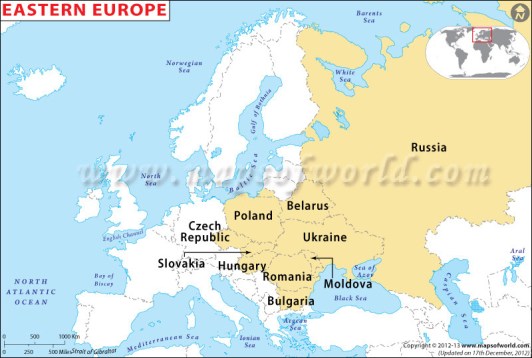
- HUNGARY
Overview
Hungary was an important medieval kingdom settled by the Uralic Magyar people in the 9th century AD. During the Middle Ages, Hungary was a crucial piece of Christian Europe’s defense against Ottoman incursion. The kingdom collapsed in the 16th century but Hungary persisted as an important battleground between Christian Europe and Muslim invaders. Hungary has remained relevant as a part of the Austro-Hungarian empire in the 1800s, the Soviet Bloc during the Cold War, and the European Union since.
History
It is generally believed that Hungary came into existence when the Magyars, a Finno-Ugric people, began occupying the middle basin of the Danube River in the late 9th century. According to the “double-conquest” theory of archaeologist Gyula László, however, Hungary’s creation can be dated to 670, with the arrival of an earlier wave of conquerors, the Late Avars, whom László classified as the Early Magyars.
Hungary’s more than 2,000 years of violent history has unified its people and influenced its culture. Heritage and tradition are important to Hungarians, and are displayed in the country’s national celebrations, folk music, dance and in the strong family ties reaching across generations.
The region now known as Hungary was a part of the Roman Empire until its fall in the 4th century, after which the powerful Hun controlled the land. Subsequently, a number of smaller Middle European empires passed through until the 9th century when the Magyar tribes formed a unified federation. Christianity arrived during the next 100 years and the first Hungarian king, later to be beatified as St Stephen, ruled over the Catholic Apostolic Kingdom.
Culture
The rich culture of Hungary is strong in folk traditions and has its own distinctive style, influenced by the various ethnic groups including the Roma people. Music of all kinds, from classical to folk, is an important part of everyday life, as is the country’s rich literary heritage. Crafts such as ceramics and embroidery, Hungary’s distinct, traditional cuisine, strong fruit brandies, dance and the ever-popular spa treatments all reflect the heritage of this fascinating country.
Hungary’s 10 million people are vibrant, friendly and value the family above all else, with generations living in the same household under one roof and grandparents having a strong say in the upbringing of their grandchildren. Hungarians are a nation of horsemen due to their ancient nomadic past, and visitors often receive an invitation to go riding from their new local friends. Hospitality is a major part of the culture here, and personal questions about your life are all part of the getting-to-know-you process.
youtube link for ancient hungarian culture –

Within the often changing borders of Hungary during its history, fine arts developed in strong interaction with European art, and although they always reflected European tendencies, they retained a strong character of their own.
- http://civilization-v-customisation.wikia.com/wiki/Hungary_(Stephen_I)_(JFD_and_Janboruta)
- https://www.britannica.com/place/Hungary/History
- https://www.iexplore.com/articles/travel-guides/europe/hungary/history-and-culture
- http://visit-hungary.com/culture/architecture
2. CZECH REPUBLIC
History
Probably about the 5th century A.D., Slavic tribes from the Vistula basin settled in the region of Bohemia, Moravia, and Silesia. The Czechs founded the kingdom of Bohemia and the Premyslide dynasty, which ruled Bohemia and Moravia from the 10th to the 16th century. One of the Bohemian kings, Charles IV, Holy Roman Emperor, made Prague an imperial capital and a center of Latin scholarship. The Hussite movement founded by Jan Hus (1369?–1415) linked the Slavs to the Reformation and revived Czech nationalism, previously under German domination. A Hapsburg, Ferdinand I, ascended the throne in 1526. The Czechs rebelled in 1618, precipitating the Thirty Years’ War (1618–1648). Defeated in 1620, they were ruled for the next 300 years as part of the Austrian empire. Full independence from the Hapsburgs was not achieved until the end of World War I, following the collapse of the Austrian-Hungarian Empire.
A union of the Czech lands and Slovakia was proclaimed in Prague on Nov. 14, 1918, and the Czech nation became one of the two component parts of the newly formed Czechoslovakian state. In March 1939, German troops occupied Czechoslovakia, and Czech Bohemia and Moravia became German protectorates for the duration of World War II. The former government returned in April 1945 when the war ended and the country’s pre-1938 boundaries were restored. When elections were held in 1946, Communists became the dominant political party and gained control of the Czechoslovakian government in 1948. Thereafter, the former democracy was turned into a Soviet-style state.
Nearly 42 years of Communist rule ended with the nearly bloodless “velvet revolution” in 1989. Václav Havel, a leading playwright and dissident, was elected president of Czechoslovakia in 1989. Havel, imprisoned twice by the Communist regime and his plays banned, became an international symbol for human rights, democracy, and peaceful dissent. The return of democratic political reform saw a strong Slovak nationalist movement emerge by the end of 1991, which sought independence for Slovakia. When the general elections of June 1992 failed to resolve the continuing coexistence of the two republics within the federation, Czech and Slovak political leaders agreed to separate their states into two fully independent nations. On Jan. 1, 1993, the Czechoslovakian federation was dissolved and two separate independent countries were established—the Czech Republic and Slovakia. The Czech Republic joined NATO in March 1999.
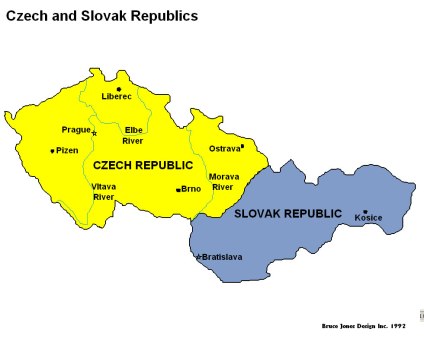
Culture
On first impression, Czechs often come across as quiet and polite, moreover, reserved and modest. This is until the evening begins and they switch into social mode, hitting the pubs and taverns, and celebrating their love of music, dancing and beer. Czechs are typically straightforward and honest people, calm and laid-back, happy to talk about politics and religion, often with very liberal views.
Etiquette is very important in the Czech Republic; they are courteous and pay respect to those who are well-mannered, frowning on rude, strange and anti-social behavior. Social greetings are important, and it’s polite to say Dobrý den (“hello, good day”) when meeting someone other than close friends or family.
The Czechs love their sports, with football (soccer) and hockey by far the most popular spectator sports in the country. Their professional players rank among the best in the world, and both sports have a popular domestic league, with the national teams usually doing well in both. The Czechs also enjoy lots of outdoor activities such as cycling, skiing, fishing, and hiking, making good use of their large national parks.
Politics
The Czech Republic is a parliamentary democracy. Its supreme law is the Constitution of the Czech Republic together with the Charter of Fundamental Rights and Freedoms. In its current form the Constitution has been valid since 1 January 1993, i.e. since the date the independent Czech state was established, as a result of the separation of Czechoslovakia.
Power is divided into legislative (Czech Parliament), executive (Czech Government and the President of the Republic) and judicial.
Colonies
The Czech Republic is almost a German colony for example Germany controls the exchange rate of the Czech Crown. Germany also forbids the Czech Republic to enter the Eurozone.
Architecture
The Renaissance brought architecture back to a human scale. A divergence from medieval religious dogmatism and mysticism, with humanist thinking and an emphasis on the power of reason and a return to ancient traditions had a calming influence on structural forms and gave them more balanced proportions, whilst also providing architecture with a lucid, civil order, a new functionality and a feeling for the joyful things of terrestrial life.
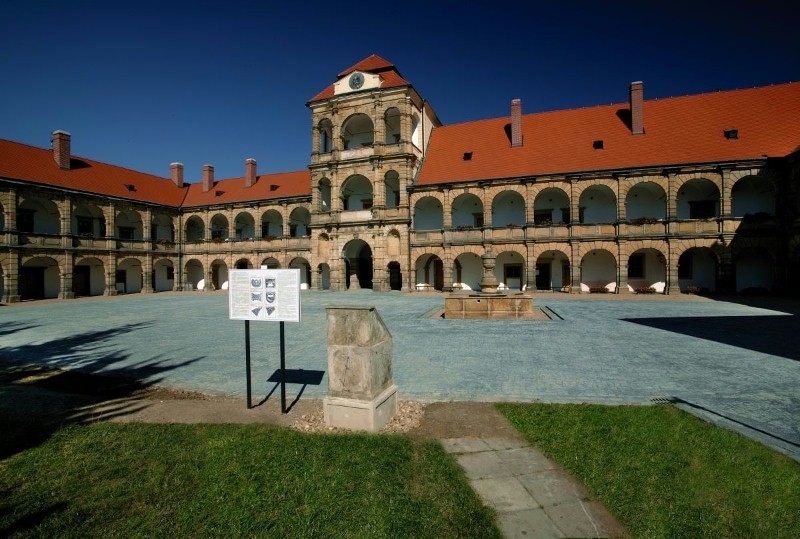
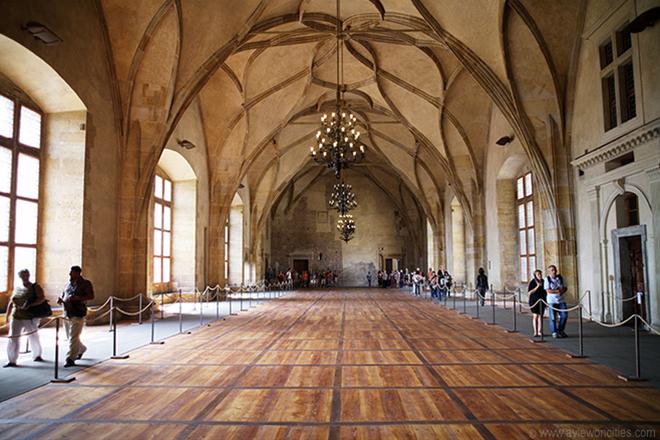
On its journey north of the Alps from its native Italy, Renaissance art and its authors found an outstanding creative milieu in Bohemia and Moravia, which was rich with investors and builders who were knowledgeable from centuries of gothic constructional craftsmanship. The first Renaissance building in a Czech setting is probably the chateau gate in Moravská Třebová, which dates from 1492, and the Vladislav Hall in Prague Castle from 1493.
Moravská Třebová –
Vladislav Hall in Prague Castle-
- https://www.infoplease.com/country/czech-republic
- https://demrepubnepal.blogspot.com/2015/04/the-splitting-of-czechoslovakia.html
- https://www.iexplore.com/articles/travel-guides/europe/czech-republic/history-and-culture
- http://www.czech.cz/en/88070-czech-republic-political-system
- https://euvsdisinfo.eu/report/the-czech-republic-is-almost-a-german-colony-for-example/
- http://www.czech.cz/en/culture/czech-arts/architecture/the-history-of-architecture
- http://en.ceskomoravskepomezi.info/moravska-trebova-castle/
- https://www.pragueticketoffice.com/prostoradetail.aspx?id=vladislavsky-sal-prazsky-hrad&lang=en
3. ROMANIA
History
What is now Romania has been inhabited since the Paleolithic Age
as evidenced by carved stone tools unearthed there.
10,000 B.C.
Approximate date of the first known art in present day Romania: cave paintings in northwest Transylvania.
4,000 B.C.
Approximate date of pottery (dated to the Neolithic Age) that is found in all regions of Romania.
3,000 B.C.
Thracian tribes of Indo-European origin, who migrated from Asia, occupied the actual territory of Romania.
2,000 B.C.
A distinctive Thracian sub-group emerged in what is now Romania.
The Greeks called these people Getae, but to the Romans they were Dacians.
Herodotus called them “the fairest and most courageous of men”
because they believed in the immortality of the soul and were not afraid to die.
700 B.C.
Greeks arrived and settled near the Black Sea.
The cities of Histria, Tomis (now Constanta) and Callatis (now Mangalia) were established.
Western-style civilization developed significantly.
70-44 B.C.
Dacian king Burebista controlled the territory of modern-day Romania.
Burebista created a powerful Dacian kingdom.
100 A.D.
Dacian civilization reaches its peak.
Their lands were rich in minerals, and they acquired great skill in metalworking.
They traded with the Greek world, importing pottery, olive oil, and wine,
and may have engaged in slave dealing.
Compared with their neighbors they enjoyed a high standard of living, as well as a rich spiritual life.
Military, the Dacians were less advanced.
Unlike the Roman legions, they did not field a standing army,
although there was a warrior class, the comati, or ‘long-haired ones’. ”
(attribution: Anthony Everitt, Hadrian and the triumph of Rome).
106 A.D.
Romans conquer and colonize Dacia (modern-today Romania).
106 – 274 A.D.
Dacia is a province of the Roman Empire.
Dacians gradually adopt numerous elements of the conquerors’ language.
271 A.D.
After fighting off the barbarian Goths, most Roman troops abandon Dacia.
4th Century
Christianity is adopted by the Daco-Roman, Latin-speaking people.
4th – 9th Centuries
Nomadic tribes from Asia and Europe (Goths, Visigoths, Huns, Slavs) invade Dacia.
896 — late 1100s
Magyars (Hungarians) invade regions in western and central present-day Romania
(Crisana, Banat and Transylvania).
The local population — Romanians – were the only Latin people in the eastern part of the former Roman Empire and the only Latin people to belong to the Orthodox faith.
The oldest extant Hungarian chronicle, “Gesta Hungarorum” or The Deeds of the Hungarians,
(based on older chronicles) documents the battles between the local population in Transylvania,
lead by six local rulers, and the invading Magyars.
Culture
The unique culture of Romania is the result of its position at the heart of three European regions, the Balkans, Eastern Europe and Central Europe, all of which historically enjoyed distinct cultures and histories. The cultural evolution of Romania manages to be of these cultures, yet different from them in many ways, due to the rich ethnic mix of its peoples. The roots of Romanian culture go deep, with elements of Slavic, Medieval Greek, Byzantine, Turkish, Hungarian and Saxon German influences as well as Western European flavors from the last 250 years.
Particularly in Transylvania, the ancient Roman origins of the Romanian peoples is emphasized and seen in the Latin-based Romanian alphabet, although the ancient Greek heritage counts more in Wallonia and Moldavia. Modern European cultural trends arrived during the country’s Golden Age in the early 20th century and. due to the agricultural nature of most of the land, folk traditions are as strong now as in the Middle Ages. Much-loved traditional arts include weaving, embroidery, ceramics and wood carvings, and dance styles and folk music are treasured through the many famous folk dance and music groups as well as local groups.
Politics
youtube link for the political structure for Romania.
Colonies
The earliest colonies were coast-guard communities, each containing about 300 Roman citizens and their families. By 200 BC a system of such Roman maritime colonies maintained guard over the coasts throughout Italy. The Romans preferred this form of coastal defense to the use of a fleet. The colonists kept their Roman citizenship, with all the rights thereof.
The larger Latin colonies were established for defensive purposes outside Roman territory. In 218 BC, for example, about 6,000 colonists, Latin as well as Roman, were settled in Placentia and Cremona to guard the region of the Po River following the conquest of northern Italy. At first, the Romans who moved to such colonies exchanged their Roman citizenship for generous land grants, but after 177 BCLatin colonists were considered Roman citizens.
Architecture

Pantheon in RomeThomas Jefferson intended for some of his buildings to resemble Roman temple, which he described as “one of the most beautiful, if not the most beautiful and precious morsel of architecture left us by antiquity.”
Roman structures looked more like modern buildings than their Greek counterparts. Roman structures were not just rows of columns with a roof; the columns intermingled with solid walls and arches. In the introduction of his ten-volume treatise on architecture, the Roman architect Vitruvius laid the basic rules for a good building—it had to be functional, firm and delightful.
Roman architecture was oriented towards practical purposes and creating interior spaces. Roman buildings looked heavy on the outside. One of the main goals was to create large interior spaces.
People are always going on about how uncreative the Roman were.” American archaeologist Elizabeth Fentress told National Geographic. “The Romans said it themselves. But it is just simply untrue. They were brilliant engineers. In the Renaissance, when there was this great fever for anything neoclassical, it was Roman not Greek architecture that was copied.”
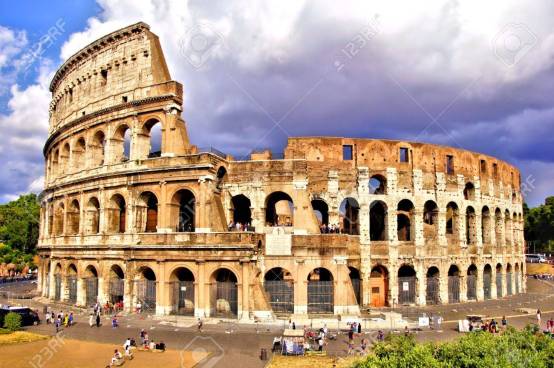
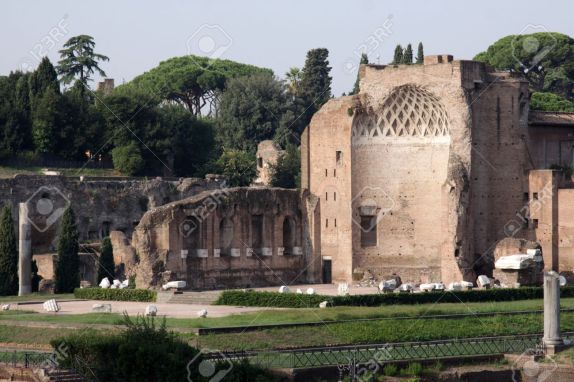
Rome reborn is a $2 million, 3-D computer project that aims to make all of Rome in A.D. 320 visible with the click of mouse. Launched by UCLA and now based at the University of Virginia it has recreated 7,000 buildings and 31 monuments, including the Colosseum, the ruined Temple of Venus and the ruined Roman Senate.
Colosseum-
Ruined Temple of Venus-
- http://romaniatourism.com/history.html#ancient
- https://www.iexplore.com/articles/travel-guides/europe/romania/history-and-culture
- https://www.britannica.com/topic/colony-ancient-Roman-settlement
- http://factsanddetails.com/world/cat56/sub369/item2062.html
- https://www.123rf.com/photo_26060855_view-of-the-colosseum-rome-italy.html
- https://www.123rf.com/photo_13110459_the-ruins-of-the-temple-of-venus-in-rome-italy-.html
TILL 20th CENTURY:
- HUNGARY
History
The country was unified with Croatia after a short war in the early 12th century and, in 1217, King Andrew II led a huge royal army to the Holy Land as part of the Fifth Crusade. 25 years later, his power was crushed by a Mongol invasion, during which 20 percent of the population died. After they finally retreated, the country, along with the rest of medieval Central Europe, fell into several centuries of warfare including unsuccessful invasions by Ottoman forces.
By the early 16th century, Hungary lost its international importance due to weak kings and peasant unrest, and a revolt in 1514 gave the Ottoman Turks the momentum they needed at the Battle of Mohacs in 1541. Hungary was divided into three, and the Turks remained in control until the late 17th century, when a joint army known as the Holy League recaptured the Buda region and went on to reclaim the country for its people in 1717.
Serbs, Slavs and Germans were bought in to repopulate the land, and Hungary’s ethnic composition was forever changed. Local conflict continued with an uprising led by Francis II, who briefly became Ruling Prince of Hungary, and war with the Austrian Hapsburg Empire continued for eight years, followed by the Napoleonic Wars. Throughout the first half of the 19th century, the country attempted reform and fell back into confusion until 1867, when the Dual Monarchy of Austria-Hungary was formed, the Hungarian Constitution restored and Franz-Joseph crowned king.
Austro-Hungarian armies played a part in WWI and, by 1918, Hungary’s economy had collapsed and military anarchy ruled the streets. A year later, the Communist Party took power and the Hungarian Soviet Republic was declared, although by 1920 power was restored to the monarchy and the country was a parliamentary democracy. Hit hard by the Great Depression and with WWII looming, the country again fell victim to autocratic tendencies, resulting in it joining forces with the Axis powers and entering the conflict.
Soviet forces invaded Hungary in late 1944, finding a devastated country and a decimated population. It remained a Soviet Communist bastion until the successful 1989 uprising, as a result of which Mikhail Gorbachev agreed to accept Premier Karoly Grosz’s demands. Free elections took place in 1990, and Soviet forces finally left in June 1991. Hungary’s hard-fought independence paved the way for the fall of the Berlin Wall and the end of the Soviet era and the Cold War.
2. CZECH REPUBLIC
History
The Czech state can be traced back to the early Middle Ages, but it wasn’t until the 13th century when a significant kingdom was established. It was during the 14th century, under the rule of Charles IV, fondly known as the Czech King and Holy Roman Emperor, that the Czech lands gained any considerable power, with the area later becoming part of Austria under the Austro-Hungarian Empire in 1867.
After the fall of the empire and the tragic events of WWI, the Czechs and Slovaks won independence and in 1918, formed Czechoslovakia, which was declared a sovereign country. The area grew, developing great infrastructure and power, and becoming a significant political force through most of the 1920’s and ‘30s, but that all changed in 1938 when Hitler led an invasion into Czechoslovakia that split the country into three states, Bohemia, Moravia and Slovakia.
Czechoslovakia was reformed again in 1945, after Hitler’s defeat and the end of WWII, but much of the eastern portion was handed over to the Soviet Union and became the Ukraine. The end of the war also resulted in a change in government with the Communist Party wining the 1946 elections, leading Czechoslovakia into a new era.
A lot of friction and tension built up throughout the 1950s and ‘60s, with regular protests against the repressive socialist regime, giving birth to the movement known as the Velvet Revolution. This uprising, led by students and intellectuals, gained great attention in 1989 when the peaceful protests on November 17th turned violent after aggressive policing. This event caused the communist regime to step down and hold free parliamentary elections in June 1990, resulting in a new democratic rule.
It was two years later toward the end of 1992 that Czechoslovakia split into the Czech Republic and Slovakia. Both countries gained stability and free government, with the Czech Republic successfully joining NATO in 1999 and the European Union in 2004.
3. ROMANIA
History
Invasions by Goths, Huns, Bulgars and various other tribal kingdoms continued until the Middle Ages, by which time the population had settled into three distinct principalities, Transylvania, Moldavia and Wallachia.
During the 11th century, Transylvania was an autonomous region of the Hungarian kingdom and regained its independence as a principality as late as the 16th century before losing it again in 1711. Over the same period, Moldavia and Wallachia contained a number of smaller, independent, states until the 14th century, when both regions emerged as larger principalities due to the threat of Ottoman invasion. However, by 1541, the entire Balkan peninsula including most of Hungary was under Ottoman rule.
Full or partial internal autonomy was the hallmark of the Ottoman era for Transylvania until 1699 and for the rest of the region until the 19th century. During this period, the Romanian feudal system was slowly eradicated and distinguished rulers such as Stephen the Great and Vasile Lupu in Moldavia, Matel Basarab and Constantin Brancoveanu in Wallachia and Gabriel Bethlen in Transylvania held their regions together.
The successful Great Turkish War in 1699 brought Transylvania under the control of the powerful Austrian Hapsburg Empire, although Wallachia and Moldavia spent several more centuries in political instability and conflict. By 1718, Hapsburg armies had subdued part of Wallachia, which they held until 1739, and in 1775 northwestern Moldavia was taken. In 1812, Russian armies occupied eastern Moldavia. During most of the years of Austria-Hungarian rule, Romanians were treated as serfs and second-class citizens.
Uprisings began in 1821, culminating in a failed attempt at revolution in 1848, after which the Great Powers of Europe refused to support Romanian demands for unity and independence, forcing Romania to stand alone against the Turks. Moldavia and Wallachia elected Alexandru Ioan Cuza as their ruler, uniting the two regions and becoming the foundation of Romania, although Transylvania was excluded.
The Russo-Turkish war saw the region fighting on the Russian side, and the resulting Treaty of Berlin finally saw Romania recognized by the Great Powers and the Ottoman Empire. Between 1878 and 1914, the united country saw progress and stability and declared neutrality when WWI broke out. However, two years later, the Allies piled pressure on the country and forced it to declare war on Austria-Hungary. Disaster struck immediately, with the Central Powers taking two-thirds of the country.
By the war’s end, the Russian Empire and Austro-Hungary were in a state of total collapse and, by 1920, all regions occupied by Romanians were drawn together to form Greater Romania. At the beginning of WWII, the country again claimed neutrality, but a Soviet ultimatum threatening invasion forced its leaders to capitulate, surrender northern Bukovina and Bessarabia provinces, but joining the Axis. Romanian lands were ceded to Bulgaria and Hungary, and the country became a National Legionary State under Ion Antonescu.
Romania became a crucial source of oil for Nazi Germany, enduring crushing bombing raids by the Allies as a result. Antonesco’s regime played an important role in the Holocaust, taking on the Nazi program of oppression and eradication and including Romania’s Roma population. Over 280,000 Jews and 11,000 Roma were murdered during this period.
Worse was to come when, in 1948, the Soviet army occupied Romania, declaring it a People’s Republic. The military occupation continued until the late 1950s, during which time the country was stripped of its vast natural resources. The Communist reign of terror until the 1960s saw the secret police torture and murder ‘enemies of the state’. However, Romanian armed opposition to Communism was the most organized and effective in the Eastern Bloc. In 1965, Nicolae Ceausescu came to power, introduced independent policies and condemned the USSR’s invasion of Czechoslovakia.
By the 1980s, Romania was foreign debt-ridden, with Ceausescu’s cult of personality decreasing his popularity and finally resulting in the bloody 1989 Romanian Revolution, during which the deluded leader was captured and executed. Communist repression during the period under USSR control directly resulted in the deaths of over two million people, not including those who died in liberty as a result of injuries sustained in the prisons. Sadly, after the revolution, violence and unrest continued under Ion Iliescu until as late as the 1990s.
- https://www.iexplore.com/articles/travel-guides/europe/hungary/history-and-culture
- https://www.iexplore.com/articles/travel-guides/europe/czech-republic/history-and-culture
- https://www.iexplore.com/articles/travel-guides/europe/romania/history-and-culture
– MAHEK SARAOGI
 History Of European Architecture