HISTORY OF EASTERN EUROPE THROUGH ARCHITECTURE.
- HUNGARY
Roman Architecture

Architecture in the Roman Empire was a social art, meant to benefit the community. Many innovations by the Romans were influenced by this purpose, and soon a new architectural style was born. Examples include roads, aqueducts, baths, basilicas and amphitheaters.The Roman Empire once covered a major part of today’s Hungary and there are many Roman ruins throughout the country. One of the main settlements was Aquincum, the ancestor of Budapest, located in the area known today as Óbuda. Aquincum consisted of two key districts: a military camp and a civilian settlement.
Gothic & Neo-Gothic

Matthias Church
Gothic architecture saw the creation of soaring arches to draw the spirit of man up to heaven. Its characteristics include the pointed arch, the ribbed vault and the flying buttress. It is in the great churches, cathedrals, abbeys and in a number of civic buildings that the Gothic style was expressed most powerfully. Buildings to look for are No. 18, 20 and 22 on Országház utca, which date back to the 14th century and No. 31 Úri utca, that has a Gothic façade that dates back to the 15th century. Another building with Gothic remains is the the Inner City Parish Church in Pest. The most characteristic Gothic-style buildings are actually Neo-Gothic, like the Parliament Building and Matthias Church, where much of the original material was used.
Renaissance & Neo-Renaissance

Hungarian Academy of Sciences
The Renaissance style places emphasis on symmetry, proportion and geometry. It is a revival of certain elements used in ancient Greek and Roman architecture, first developed in Italy. One of the earliest places to be influenced by the Renaissance style of architecture was Hungary. The style appeared following the marriage of King Matthias Corvinus and Beatrix of Naples in 1476. Many Italian artists, craftsmen and masons came to Buda with the new queen. Renaissance era ruins are in Visegrád, where King Matthias had a second, and equally beautiful, Renaissance-style Royal Palace. Hungary is in Neo-Renaissance, buildings like the famous Opera House, the St. Stephen’s Basilica and the Hungarian Academy of Sciences belong to the list of must-see attractions.
Ottoman (Turkish) Architecture
Király Baths
During the Turkish occupation (1541-1686), multiple mosques and baths were built in Buda. These were great examples of Ottoman architecture, which was influenced by Iranian, and to a larger extent, Byzantine architecture as well as Islamic traditions. It’s a mixture of the Mediterranean and the Middle East , in fact one of the few places in the world with functioning original Turkish bathhouses dating back to the 16th century. Another little known fact is that Budapest is home to the northernmost holy place of Islam, the burial place of a Turkish dervish called Gül Baba.
Baroque & Neo-Baroque

Széchenyi Baths
The Baroque style designated the dominant style of art in catholic countries from the 17th century to the 18th century. Baroque originated in Rome and its success was encouraged by the Roman Catholic Church. It fit the church’s demands for an architectural style to communicate religious themes by appealing to the senses, often in dramatic ways. It also made a visible statement of the wealth and power of the Church. The emphasis was on colonnades, domes and the use of light-and-shade with qualities of richness, drama, vitality, movement, tension and emotional exuberance. There are many Baroque-style buildings in Budapest and Hungary and one of the finest examples of original Baroque-style architecture is the Church of St. Anna in Batthyhány tér.
Classicism & Neo-Classicism

Hungarian National Museum
Classicism puts emphasis on symmetry, proportion and geometry. The style is principally derived from the architecture of Ancient Rome, of which many examples remained. Hungary had not one but two architects that were masters of the Classicist style. Mihály Pollack (1773-1855) and József Hild (1789-1867), built many beautiful Classicist-style buildings in the country. Some of the best examples are the Hungarian National Museum, the Lutheran Church in Deák Ferenc tér (both designed by Pollack) and the Basilica in Esztergom (a design by Hild). Interestingly, the most iconic Classicist-style attraction is Chain Bridge, was not designed by a Hungarian. It’s the creation of English engineer William Tierney Clark.
Romantic Style

Vigadó
Romantic architecture stresses the aesthetic appearance. This is also the time of the Industrial Revolution and exploration on structure, such as the use of iron, begins. Two most beautiful Romantic-style buildings are the Great Synagogue in Dohány Street and the Vigadó Concert Hall on the Danube Promenade, both designed by architect Frigyes Feszl (1821-1884). Another noteworthy structure is the Western Railway Station, which was designed by August de Serres and built by the Eiffel Company of Paris.
Art Nouveau

Hotel Gellért
Art Nouveau encompasses many different art forms including architecture, applied arts and fashion, amongst others. This art movement of the early 20th century had many national schools in Europe and Hungary was no exception. Nevertheless, the Vienna Secession, the German Jugendstil, and Art Nouveau from Belgium and France are all reflected in the buildings constructed at the turn of the 20th century. Art Nouveau in Hungary or Szecesszió is a blend of several architectural styles, with a focus on Hungary’s eastern origins. One of our leading Art Nouveau architects, Ödön Lechner (1845–1914), was inspired by Indian and Syrian architecture as well as traditional Hungarian decorative designs. One of his most beautiful buildings in Budapest is the Museum of Applied Arts.
2. CZECH REPUBLIC
MIDDLE AGES
The Middle Ages were primarily characterized by the wealth and power of the Catholic Church: securely fortified monasteries as spiritual sanctuaries and centers of education as well as arched Gothic cathedrals ingeniously inclined toward heaven, which diverted the attention of the insignificant individual from the burden of earthbound matters. The oldest of these buildings include the monasteries in Osek, Nepomuk and Velehrad (which is an important place of pilgrimage for the Catholic Church). Original Bohemian Gothic developed its own constructional skill resulting in the grandiose spatial compositions of the late period with complex systems of reticulated vaulting (Benedikt Ried).
 cistercian monastery osek
GOTHIC
Starting in the 13th century, Gothic architecture influenced the Czech milieu for three whole centuries. Increasingly affluent towns underwent their first reconstruction, and new towns were established based on a large-scale concept. Ideal conditions arose for artistic work at the time of the first great expansion of the Bohemian state in the 14th century. With the support of Charles IV in particular (a king who was a sovereign in the grand European style), important building works were also created in the style of High Gothic under the direction of first-rate foreign and local architects(Matthias of Arras, Petr Parléř and others). :max_bytes(150000):strip_icc()/Prague_Castle_By_Night-56b787c65f9b5829f839d952.jpg) Prague Castle
Prague Castle
Prague Castle was restored by Charles IV, the son of John of Luxemburg. In 1356, he drafted the 23-year old Petr Parléř into his service. Parler was an architect of European caliber and, in terms of both culture and building works, Bohemia found its place in the European sun for half a century. In Prague, which was fortified with ramparts, dozens of cloisters (the Emause and Virgin Mary of the Snow cloisters) were built, which made use of the relative safety of the town. Countless churches, stone buildings, a bridge and a cathedral were built.
RENAISSANCE
The Renaissance brought architecture back to a human scale. A divergence from medieval religious dogmatism and mysticism, with humanist thinking and an emphasis on the power of reason and a return to ancient traditions had a calming influence on structural forms and gave them more balanced proportions, whilst also providing architecture with a lucid, civil order, a new functionality and a feeling for the joyful things of terrestrial life. On its journey north of the Alps from its native Italy, Renaissance art and its authors found an outstanding creative milieu in Bohemia and Moravia, which was rich with investors and builders who were knowledgeable from centuries of gothic constructional craftsmanship. The first Renaissance building in a Czech setting is probably the chateau gate in Moravská Třebová, which dates from 1492, and the Vladislav Hall in Prague Castle from 1493.
Chateau gate in Moravská Třebová
Prosperous burghers modernized their houses, town halls and purpose-built constructions. In the 16th century, the humanist-educated nobility moved from uncomfortable gothic castles to newly built spacious chateaux with elegant arcade courtyards and geometrically arranged gardens with fountains and statues. Emphasis was placed on comfort, and buildings that were built for entertainment purposes also appeared (ball-game halls, riding halls, summer palaces, orangeries).
BAROQUE
The beginning of the 17th century brought a new vision of loose shapes to architecture. Under pressure from a return of religious fervor, this developed into a dynamic Baroque style. The drama of material, meaning and spirit in architecture once again faithfully reflected the political situation in Central European society as well as the drama of its ethics and culture.
Its relationship to the local environment was particularly intensified in the early Baroque phase by Italian building families (Lurago, Orsi, Carlone, Tencalla).
For reasons of prestige, rich nobles (the Liechtenstein and Černín families) invited famous architects to the country, who raised the standard of local architecture (Giovanni Santini, also known as Jan Blažej Santini Aichl); Giovanni Alliprandi and Kilián Ignác Dientzenhofer).
The years 1700-50 are associated with a supreme, dynamic, radical Baroque – a version of the style that Czech architects took further than most of Europe. Specific and completely distinctive chapters in Czech Baroque comprise the so-called baroque-gothic, which is exclusively represented by Jan Blažej Santini and rustic Baroque.
ROCCO AND CLASSICISM
The great artistic efforts of high Baroque reverberated in the Czech lands for a long time until after the mid-18th century. This primarily manifested itself in interiors in the miniature shapes of rococo. This was completely subdued by a re-inclination toward classicism. It was first presented through the reconstruction of Prague Castle, and continued all the way up to the mid-19th century, particularly with the construction of chateau summer houses (Kacina) or large-scale garden complexes with ostentatious garden architecture (the Lednice-Valtice region – the Three Graces in front of the imperial church with a colonnade).
Chateau Summer Houses (kacina)
The tone of style was indicated by France: imposing chateaux with pillars, theater buildings, colonnades, pavilions, obelisks and triumphal arches were reminiscent of the glory of the ancient world just like the ideas arising out of the French Revolution and imperial Bonapartism. Together with restrained expressions of classicism, early romanticism spread to architecture.
ROMANTIC HISTORICISM
With the 19th century, the era of great stylish epochs faded away. At the same time, these became the subject of interest for systematic study by modern architects, and they gave them scope for imitation in new buildings and extensive reconstructions of older works. Romantic historicism primarily drew on English and German models and was progressively inspired by all building styles and combinations of their elements.
It left a multitude of buildings in its wake: castles and chateaux rebuilt in the image of enchanting royal seats, town halls, churches, schools, bath houses, guesthouses and entire blocks of town houses. Moreover, the neo-Renaissance style became a means of expression for the Czech National Revival , and a symbol of the nation’s patriotic ability to manage its own affairs in art and politics.
Shortly before the end of the 19th century, the Czech milieu adopted the spirit of Art Nouveau from nearby Vienna. Numerous villas and apartment buildings were erected along with prestigious buildings such as the main train station or the Municipal House in Prague.
3. ROMANIA
PRE- MODERN STYLES
During the middle ages in Romania there were two types of construction that developed in parallel and different in point of both materials and technique. The first is the popular architecture, whose most spectacular achievements were the wooden churches, especially those in the villages of Maramureş, Banat and Apuseni Mountains, where the tradition is still carried out today. In Maramureş, in Surdeşti village, the 54 m high church tower built during 1721–1724 is among the highest of this kind in Europe. The second consists mainly of monasteries, as well as princely seats or boyar mansions. In medieval architecture, influences of Western trends can be traced, to a greater or lesser extent, in all the three lands inhabited by Romanians. Such influences are stronger in Transylvania, and weaker in Moldavia, in forms absorbed by local and Byzantine tradition. In Wallachia, Western elements in architecture were even fewer; there, from the 14th-century architecture was based on the local adaptation of the Byzantine model (the Princely Church in Curtea de Arges and the Cozia Monastery). There are monuments significant for the Transylvanian Gothic style preserved to this day, in spite of all alterations, such as the Black Church in Braşov (14th and 15th centuries) and a number of other cathedrals, as well as the Bran Castle in Braşov County (14th century), the Hunyad Castle in Hunedoara (15th century).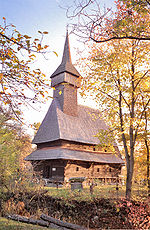 Wooden church in Maramureş
MODERN ERA ARCHITECTURE (19th CENTURY)
The first half of the 19th century, urban life grew considerably and there was a Western-oriented modernization policy. Thus the architecture of Romanian cities became a combination of Romanticism and Neoclassical elements. In the second half of the century a historicist Neo-Romanian National Romanticism style developed, using elements and forms of the traditional and local vernacular architecture. Ion Mincu (1852–1912) was founder of both trends, and of the Romanian School of Architecture. His works, including the Lahovary House or the Central Girls School in Bucharest, are among the most prominent achievements of the Romanticism movement. The Romanian School designed residences and administrative buildings in several neoclassical styles. One was the classic revival style, such as the Grigore Antipa National Museum of Natural History, and the Cantacuzino Palace (George Enescu Museum). The numerous Parisian style buildings initiated Bucharest’s nickname as “Little Paris”. Industrialization brought some engineering feats such as the King Carol I Bridge (later renamed Anghel Saligny Bridge). Built between 1890 and 1895 in over the Danube, when it was completed it then became the longest bridge in Europe and the third in the world.

Danube bridge
20th CENTURY
In the first decades of the 20th century, Romanian towns and cities still had a contrasting aspect, exhibiting a sharp difference between the downtown sumptuous buildings and the almost rural outskirts, while the villages remained, architecturally speaking, mainly unchanged. Nevertheless, the first signs of town planning appeared in some urban districts (the first two- or three-storied blocks of flats or one-family houses on two levels).
The Symbolist movement in Romania introduced the Art Nouveau style. The Art Deco style was introduced during the Interwar period, with examples including the Bucharest Telephone Palace (Palatul Telefoanelor, 1933) and former “National Stadium” (Stadionul ONEF, 1926). Other important architects, such as Horia Creanga (1893–1943) and Duiliu Marcu (1885–1966) stood out by their commitment to simple forms and Functionalist styles. Examples include: the Bucharest North railway station (București Gara de Nord) and National Bank of Romania headquarters (new NBR Palace, early 1940s).

Art Nouveau elements, Deva Theater, Deva, Romania
http://visitbudapest.travel/guide/budapest-architecture/
http://www.czech.cz/en/66608-the-history-of-architecture
http://wikimapia.org/10578970/Osek-Cistercians-Monastery
https://www.tripsavvy.com/photo-tour-of-castle-hill-prague-1501391
http://www.czechtourism.com/t/moravska-trebova/
https://bohemia-trip.cz/en/zamek-kacina-an/
https://en.wikipedia.org/wiki/Romanian_architecture
– MAHEK SARAOGI
 History Of European Architecture